Trade Winds

The 2026 Major League Baseball trade deadline has come to pass. There was a flurry of activity Monday afternoon that provided some surprising moves, none of which were exceedingly shocking.

The big news of the trade deadline actually broke late Saturday evening when it was announced that the Los Angeles Dodgers have come to terms on a trade with the Detroit Tigers to acquire ace lefty Tarik Skubal.

Skubal is the back-to-back reigning American League Cy Young winner, and the first reigning winner to be traded in-season since Justin Verlander in 2023 — only the sixth ever. He led all of baseball in WAR and strikeouts in 2024 and went a combined 31-10 with 469 punchouts across 2024 and 2025. There was talk he may not be traded at all this year after he had loose bodies removed from his elbow in May and was back on a mound 38 days later. The Dodgers are now the first team in league history to have a reigning two-time MVP and a reigning two-time Cy Young winner on the roster together in the same season.

Unlike most baseball fans, I was happy to hear the news. The most important reason for that is my hope was that he would not end up on the New York Yankees. The Yankees had a rather quiet deadline, but they did acquire Luis Garcia Jr. from the Nats, he leads the NL in slugging percentage. GM Brian Cashman seems to like his team’s chances should they get Judge, Stanton and Bellinger back healthy before the end of the season. 

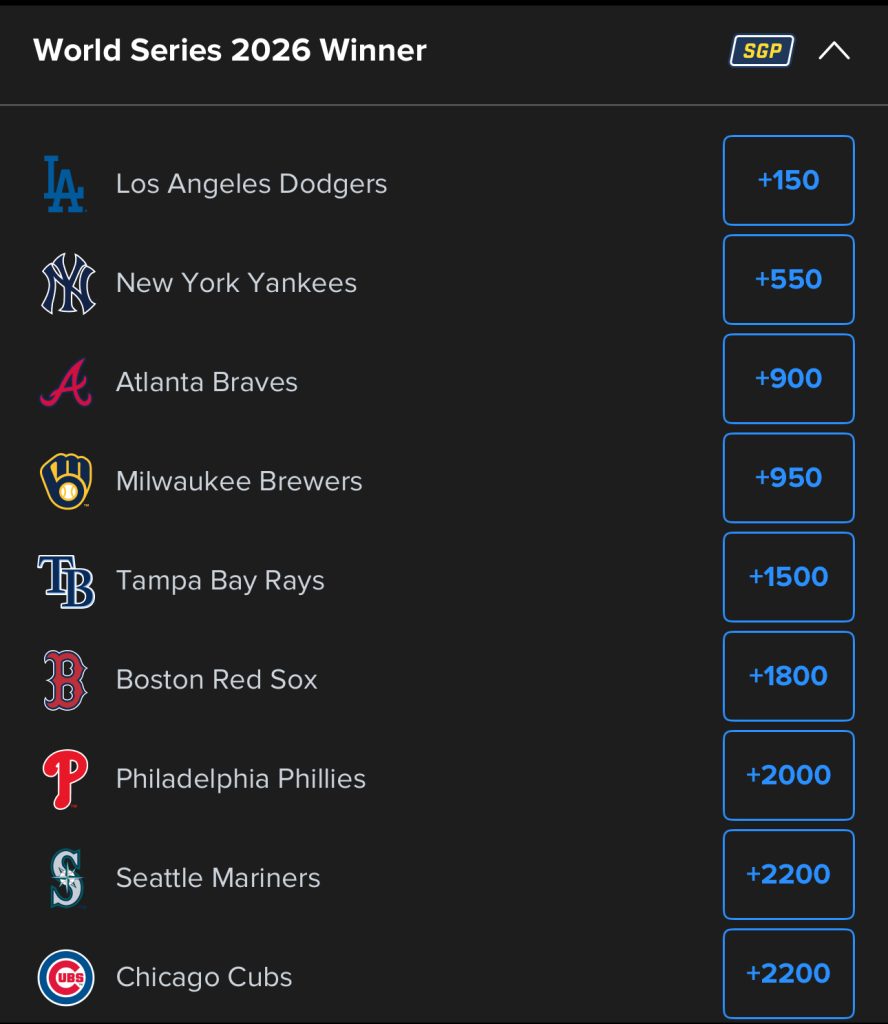
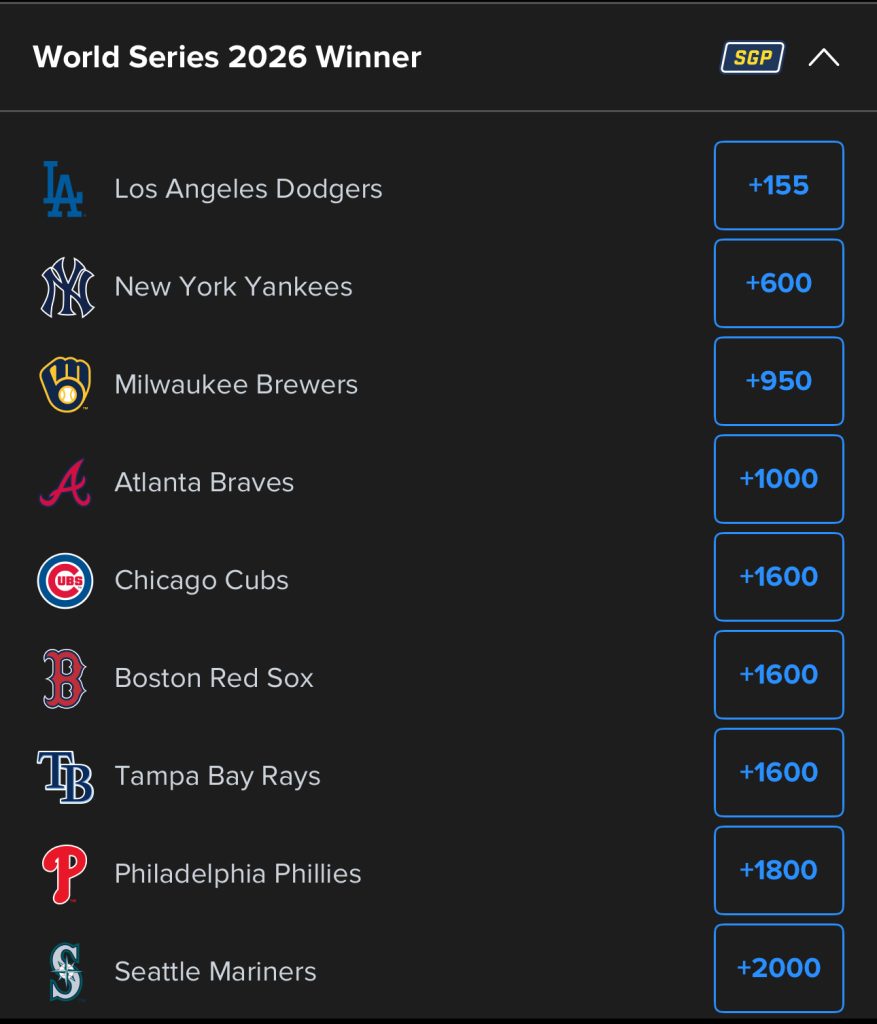
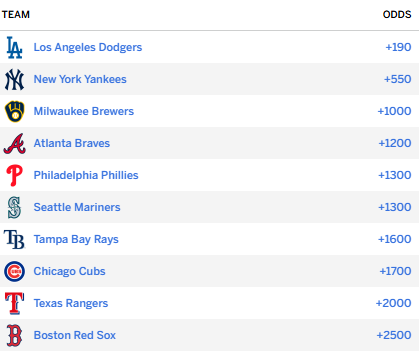
Failing to acquire Skubal hasn’t cost the Yankees much in the way of championship odds with only a slight drop from +550 Sunday afternoon to +600 Tuesday afternoon.

I screencapped two sets of odds to track the movement on FanDuel, giving a wide enough birth from the deadline itself to still get a reasonable picture of the changes it brought: 

Sunday at 5 PM: 


Tuesday at Noon: 


The question that I have for the Yanks is— what would their odds currently be had they acquired Skubal?

What would the third most favored team, the Milwaukee Brewers (+950 odds) odds be if they’d acquired Skubal?

A key reason to ask, is that the Dodgers didn’t give up a whole helluva lot to get the superstar pitcher — outfielder Zyhir Hope, the No. 5 prospect in their system and No. 25 in all of baseball, right-hander River Ryan at No. 7 in the system and No. 68 overall, and right-hander Brady Smith at No. 17, per MLB Pipeline. Los Angeles managed to hold onto their top four prospects and still get a nuclear arm added to their arsenal. 

The Dodgers sit at an unprecedented +155 to win the World Series in early August. That speaks to the incredible team they have constructed, and also the weaknesses of the rest of the field.

A three-peat would give them the first one since 1998-2000, when the Yankees pulled it off, it would also elevate the cries of the Salary Cap hungry owners and the majority of MLB fans who support such a measure.

Seeing a cap and floor model in the vein of the NFL would give fans a sense that any team could win it all. Just don’t tell that to Cleveland Browns fans, hell, don’t even mention it to Bills fans. Teams that scout, draft, recruit, sign, develop and take care of their players will still have an enormous advantage, and those in low-tax, high-revenue, nice-to-live locations will have built in advantages that will become more stark in a hard capped league. 

Point being, don’t expect a salary cap to fix all your franchises woes overnight, but I do understand the appeal and would love to see what America’s pastime looked like with a more level playing field.

Other noteworthy items from the deadline:

The Boston Red Sox basically dumped one of the members of their golden age of prospects they’ve been championing for the last several years. The oft-injured Marcelo Mayer never found his groove in the big leagues, and made more headlines for his attitude and alleged off-the-diamond issues. Word is the organization felt he was detrimental to the prospect they just locked up for nine-figures last summer in Roman Anthony. Mayer was said to be a regular fixture of the New England late night scene (according to 98.5 The Sports Hub of Boston), which fed into questions about his motivations and maturity. He was shipped to the San Francisco Giants for lefty reliever Erik Miller and minor-league outfielder Carlos Gutierrez.

The Red Sox also paid a pretty heavy price to nab Adley Rutschman from the Baltimore Orioles. The switch hitting catcher is currently injured, but could provide a valuable dynamic to the Red Sox lineup heading into the final stretch of the season, and the postseason should they land a spot. I quipped that the Red Sox are now going after players who are “pre-injured”, as another key acquisition before the deadline was Curtis Mead, the former Nationals second-baseman who has some serious pop in his bat right now and could provide much needed defensive stability to the Red Sox middle infield, was injured in his first game with the Sox. A pitch struck and broke his wrist. He now heads to the infirmary with ace Garrett Crochet, who hasn’t pitched since April 25 and still hasn’t picked up a baseball after shoulder inflammation turned into a lat strain, Roman Anthony, out since May 5 with a torn ligament in his hand and no timetable, shortstop Trevor Story, on the 60-day list since sports hernia surgery in late May and only now aiming at a rehab assignment. Rutschman officially begins his Boston tenure on the 10-day list with left wrist inflammation. Which when you compare it to the medical report I just got done delivering, is actually pretty healthy! 

Boston moved from +3500 odds on July 13, to +1800 on Sunday afternoon, climbing as high as +1500 after the acquisition of Rutschman before settling to their current line at +1600. Still a dark horse by those odds, but third behind division rivals Tampa and New York in American League team odds to win it all.

The Atlanta Braves were quiet at the deadline, their odds have dropped slightly as a result. But Chris Sale did win July’s NL Pitcher of the month, and the Bravos still have big October aspirations.

My recent article, The Dead Tradeline, discussed how the expanded Wild Card slots (and the longstanding inability to trade future draft picks) makes for less excitement at the trade deadline. Far more teams being “buyers” now than sellers limits the amount of top end players who are available to be moved, and not trading future picks limits the amount of resources teams have to acquire them. I discussed how the Red Sox could greatly benefit by being deadline sellers, but their improbable win streak, and Breslow’s desire to save his General Manager job, had made that highly unlikely. The Red Hot Sox haven’t slowed down yet, having just completed a sweep of the Dodgers this past weekend, placing them at a mind-blowing 28-5 since June 24. 

The last few weeks have felt like a holding pattern as we waited for the deadline to come and lock in the rosters. Now that we’ve seen its fruits come to bear, the headline that remains: the rich get richer in LA, the Yankees don’t make major waves, and the odds of a serious labor stoppage that puts the 2027 season at risk have grown ever higher as the owners will seek to use the Dodger’s success as the smoking gun that demands a salary cap at all costs. 

So enjoy this postseason run, it may be the last one we get for a while.

Back to the Futures

A guy who opens his sports betting app every day, even multiple times a day, sounds like a guy with a real problem. But what if that guy rarely ever places a bet? What if the guy I’m talking about is me?

I treat my FanDuel account not like a digital casino in my pocket, I treat it like I would my stocks app. It turns sports into an easily readable market index.

My favorite things to check in on are Futures markets. Primarily they tell you what a team’s current odds are to win the championship, make the championship game, win their division, etc. They don’t focus on the pointspread of the next game, they assess the odds of a future event, hence the name.

One myth I see stated often in sports media is that “Vegas thinks they’re the favorite”, or that “Vegas is giving them 7 points.” While the sportsbooks themselves set the initial line based on their own in-house oddsmaker’s analysis, that line is fluid, it moves as money is placed, shifting the odds towards the money. The sportsbooks ideally want to be in the middle, where the “vig”, the cost of the action that lies in the disparity of the odds, is where they make their money. Sportsbooks can get into danger when enormous amounts of public money are on someone who is, for example, a heavy underdog, and there is no money on the other side of the bet to offset the losses if the heavily bet side wins. This causes conspiracy theories (and I’m always willing to listen to those with an open mind) to circulate when the house ends up winning anyways, but it also shows what the goal of the bet taker is, to come out ahead no matter who wins or loses, and that means moving the line to whatever is most likely going to do that.

While you might think it’s just Johnny Casual placing all these bets and they don’t reflect data driven analysis of what is most probable to occur, the homer or the casual fan bets are called “public money”, there are sports betting syndicates and professional sports bettors who bring in significant capital and move lines when they see a disconnect between their view of what the line should be and what the odds currently listed are, they’re known as the “sharps”, and they bring in the “smart money.”

Betting syndicates employ data analysts with weaponized autism that make Rain Man look like Forrest Gump. And now when you add AI models to assist these savants you get some high level hedging happening across the sports markets.

So when I pop open my sports betting app and check out the futures, I’m looking at ticker prices like investments, mathematically deduced probabilities that bring public and smart money together to give you a sense of the likelihood of a given scenario happening, like the Dodgers winning their third consecutive World Series. This allows me to treat Futures as a more scientific version of Power Rankings.

Right now the Dodgers sit at +190, the plus minus odds look funny at first glance, but here’s what they mean in plain English. If it’s a +, it means if you bet $100 you win back your stake as well as the amount after the +. Right now, bet $100 on the Dodgers, and if they win it all, you win $190, and your $100 stake, for a payout when you cash your ticket in of $290.


If it’s minus, it’s just turned around, if a favorite is -200, a $200 bet wins you $100, for a $300 total payout. The payouts are adjust for each wager amount to the correlating ratio.

In the markets you have to be aware of and account for certain levels of bias. If you’re in Las Vegas and you’re betting on the Dodgers, be aware that due to the proximity of the massive LA metro area to Vegas, that the Dodgers are often overbet by Dodgers fans who come to Vegas and take the boys in blue no matter what the line is. The sportsbooks don’t always change the lines fast enough to correct these numbers entirely (but with automated market makers this has changed significantly) and this is where the sharps like to pounce, it’s a reason they often wait until just before a game starts, until all the public money has come in, to lay massive wagers on an inflated line to get an edge. This is why you often see significant line movement before kickoff, right before a fight begins, and so on.

In my article last week, Dead Sox Come to Life, I discussed how the Boston Red Sox odds were at 35/1, or written in +/- style, +3500. As we see today in the above image, those odds have shifted to +2500, 25/1. The betting market has priced in the Red Sox 14 game win streak, now one win shy of the franchise record set by the 1946 club, and the odds of them winning the World Series have increased as more money has come in on Boston.

The Futures are a way to cut through the noise of the talking heads in the media and look at what the money is saying is going to happen, backed by some serious data analysis. The money says the most likely outcome is a Dodgers and Yankees World Series rematch. With the Dodgers having the edge in the potential matchup. But there’s a reason they play the games, the magic of sports is how often the unlikely actually occurs.

We’ll check in on where the odds have shifted after the trade deadline, and see who has done the most to best position their team for a run through October.

The Magic is Gone

I watched the first three innings of the All-Star Game last night and felt nothing. No Ohtani, Skenes not starting for the National League, Skubal not starting for the American League. It felt more like a best-stats-so-far-this-year and most-fan-votes game than an All-star game.

Sure, if I was in Philadelphia and found a last-minute ticket for around a hundred bucks, I’d go check it out. A chance to be at an All-Star Game is historic, and getting to see all these players, many of whom will be future Hall of Famers, together would be surreal. But as a spectator watching on TV, what exactly am I looking at?

I’m watching a game that has no bearing on the division races or playoff picture. My main concern is that the players I like don’t get injured, and I felt for Rays fans who had to watch Junior Caminero get hit in the hand by a 97-mph sinker. After the game, Cardinals pitcher Riley O’Brien apologized, saying, “I definitely wasn’t trying to do that. It got away from me.” Caminero took it in stride, saying, “We’re here to have fun. We’re here to enjoy the night.” I understand that, but as a fan, it wasn’t easy to do as a television viewer.

The All-Star Game has long had a problem with the relevance issue, and they errantly tried to correct it for years by awarding home-field advantage in the Fall Classic to the winner. It did give the game stakes that made it more interesting, but it was in no way fair to the teams that would meet in the World Series at the end of the year.

Every single out and every single at-bat in a baseball game has meaning. It all becomes a part of your permanent record, your career statistics, and how that measures up against others across time. No matter how mundane the play, you know that you’re watching a small piece of history. 

I think of, weirdly enough, a blockchain. And no, don’t worry, I’m not a Bitcoin maximalist who’s about to go on a diatribe about how it’s the future and everything is Bitcoin. I’m definitely not that guy.

But blockchain technology is layers and layers of code placed together that become something unique, part of this massive catalogue that comprises how the technology works. Each play in baseball is, in essence, a line of code in the history of America’s pastime.

What was on last night has no bearing on that, and it’s one of the reasons it couldn’t hold my interest for more than a few innings. I prefer to treat the All-Star break like the players who didn’t get selected, as a brief four-day reprieve from a long and grueling season to dabble in my other interests. 

Categories MLB

Dead Sox Come To Life

The Red Sox just swept the Mets to head into the All-Star break on a nine-game winning streak. Having won 13 of their last 15 games, they now sit just a half-game back of the final American League Wild Card spot.

I covered the additional Wild Card spot changing the calculus for which teams are buyers and sellers at the deadline, and the fact that the Red Sox may win themselves into a potentially worse situation by holding onto assets, in my Dead Tradeline column last week:

While they have found some momentum lately, including a recent sweep of the Yankees, they have no business considering themselves buyers at this deadline. But the slim possibility of a returning Crochet and Anthony, along with Craig Breslow’s desperation to save his general manager job, could have them thinking twice at the deadline three weeks from now.

The Red Sox need to sell, starting with Sonny Gray, Aroldis Chapman, and Jarren Duran. Restocking the cupboard that has borne less fruit than expected with the triumvirate of Roman Anthony, Marcelo Mayer, and Kristian Campbell—from varying degrees of disappointment to disaster—should be the priority. The faltering young core has them much further away from a championship window than it appeared just four months ago.

While I commend the team for overcoming significant adversity and elevating their level of play, not acquiring future assets to build around an already struggling young core could cost the team over the next five years. But hey, if they win a World Series, it would be worth it.

Now, you could consider this the ultimate Red Sox fan reaction: being upset even while they ride a nine-game winning streak and sweep both New York franchises in consecutive weeks. The issue is that Boston has such deep institutional and developmental flaws that nothing short of Craig Breslow getting fired—and, ideally, Fenway Sports Group selling the team—can fix them.

Their current odds to win it all, even sitting just a half-game back, are 35/1 on FanDuel. Breslow may see a path to short-term success that saves his job, but it could end up costing the Red Sox a brighter future.

The Dead Tradeline

Monday, August 3rd, 6 PM Eastern. The 2026 MLB trade deadline.

A trade deadline used to loom on the horizon like a Leviathan just beneath the surface. It would emerge and reshape the entire pennant race as all-stars on ending contracts were reshuffled from the bottom of the league to the championship contenders. Sometimes creating super teams, like the 2017 Astros, where the addition of Verlander and a few well-placed dugout trash cans were enough for Houston to steal a championship. 

I still follow the deadline closely, watching Foul Territory post videos each day with the latest rumors, reading articles online about who might go where.

The big fish this year is Tarik Skubal. He’s on a surging Detroit team that just a couple months ago wasn’t certain he would be pitching again this season. The combination of his return to action, Kevin McConigle’s hot bat, and Spencer Torkelson’s rise, 15 homers on the year thus far, have the Tigers in a precarious position. Just a handful of games out of the final Wild Card spot, with their playoff odds sitting somewhere in the 20-25% range depending on who you ask. In the last 24 hours Skubal’s odds of being traded on Kalshi have grown from 65 to 70%, but a 7/10 chance of trade for a guy that is guaranteed to walk after this is surprising. A weak American League that still feels wide open is another culprit in this landscape as well. Could they be foolish enough to hang onto Skubal and get nothing in return? Only the Angels could have pulled something like that off, and they did in a sense when they could have moved Ohtani for a king’s ransom before the 2023 season, but held on, he got hurt, and they got nothing. But more on them later. 

The impact of the expanded postseason on the trade deadline can’t be understated. It is one of several factors that has rewritten how the midsummer major league musical chairs play out. With two additional Wild Card spots, significantly more teams are in contention this time of year than would have been before. My old friends, the Boston Red Sox, who have had a disastrous year by all accounts and expectations, sit just 2.5 games back from the third Wild Card spot. They sit at 43-48 today, a better record than the vibes and the Boston media coverage would indicate. 

While they have found some momentum lately, including a recent sweep of the Yankees, they have no business considering themselves buyers at this deadline. But the slim possibility of a returning Crochet and Anthony, along with Craig Breslow’s desperation to save his general manager job, could have them thinking twice at the deadline three weeks from now.

The Red Sox need to sell; starting with Sonny Gray, Aroldis Chapman, and Jarren Duran. Restocking the cupboard that has borne less fruit than expected with the triumvirate of Roman Anthony, Marcelo Mayer, and Kristian Campbell — from varying degrees of disappointment to disaster — should be the priority. The faltering young core has them much further away from a championship window than it appeared just four months ago.

Breslow is also proof positive of the harm playing fast and loose at the trade deadline can do to a team. He gave up James Tibbs for two months of the herbivore Dustin May, and then, this past offseason, sent Kyle Harrison — one of the top left-handed pitching prospects in baseball, owner of a 2.82 ERA that has swelled a bit after a few recent rough starts, and the headline piece coming back in the Devers deal — to Milwaukee for Caleb “What is baseball?” Durbin. I think Caleb knows what baseball is, but he doesn’t often play like it.

The expanded Wild Card slots are not the only factor in why the motion at the deadline is down. Prospects are now hitting the big leagues in stride thanks to a multitude of reasons. Young starlings like Kevin McGonigle, Konnor Griffin, and a wave of other rookies forcing their way into everyday lineups are having an enormous impact upon arrival. Pitching machines that can replicate major league arms, pitch sequences, and velocity have shortened the learning curves for young players in a major way. Parting with a young and desirable prospect is giving up what might be a valuable and cost-controlled near- and long-term asset for a little extra postseason juice for one season.

There has been a glimmer of hope for how the trade deadline can get its mojo back. Part of a recent proposal by the owners to the MLBPA included the ability to trade future draft picks (I’ll cover the likelihood this labor dispute kills the 2027 season in greater detail in a future post). It’s something that seems absurd that it isn’t already possible. Adding the ability to trade future draft picks adds immediate liquidity to the trade market. If a small-market team like Milwaukee wants to make a move to get this team over the hump for a World Series, trading future assets allows them to do so without parting with players currently in their farm system they covet. Seeing the Brewers trade five future first-round picks to shore up this year’s team to the point of getting a World Series title would not only be incredible to witness, it may change the calculus for how strongly small-market teams are able to compete in October. It would also be interesting to see how the wild big-market big spenders like the Mets — who seem willing at times to completely throw caution to the wind in pursuit of success ($42 million a year to Bichette anyone?) — and the “I Ain’t As Good As I Once Was, But I’m As Good Once As I Ever Was” Phillies (they owe $647m to players age 33 and up) would use that new currency to mortgage their futures and truly push their chips in for a title.

Just 24 days out from this year’s deadline, we may not have seen the last of the fireworks for America 250, but we may see more alligator arms from GMs who aren’t ready to truly play their hand. If this deadline is another dud, at least there’s hope for more electric moves at the wire in the future.

Whatever happens, I don’t think anything could be more absurdly amusing than when the Angels were both hot and cold at the buzzer in 2023 — buying Giolito, Lopez, Leone, Cron, and Grichuk before the deadline, then turning around a month later and putting four of them on waivers just to dump the salary, getting absolutely nothing back for any of it. That’s not strategy, that’s just Angels baseball. There’s only one Arte Moreno.