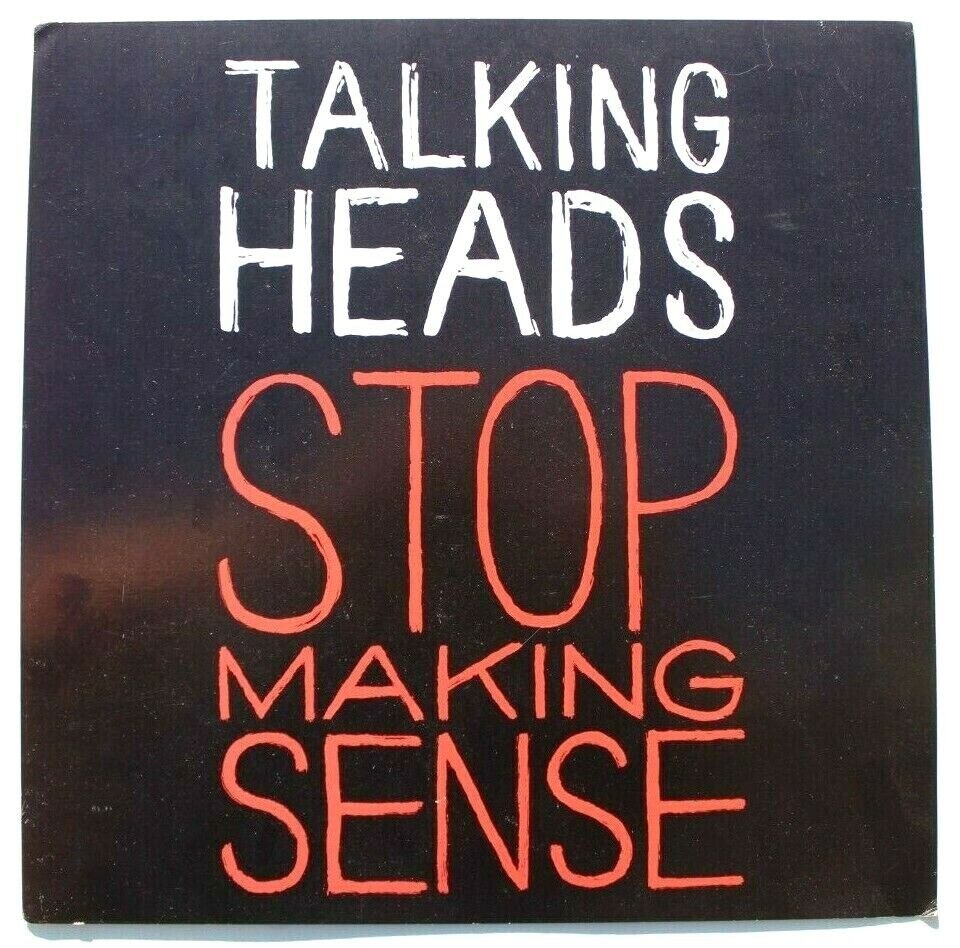
I finally watched Stop Making Sense.
It’s the Talking Heads concert film, shot by Jonathan Demme over three nights at the Pantages in Hollywood in December 1983. Frontman David Byrne walks out alone with a boom box and an acoustic guitar, and the band gets built one member at a time until it’s a nine-piece.
It had been rattling around the back of my head for years. ‘Greatest concert film ever made’, according to a lot of people with opinions I respected. But I’d never really gotten into the Talking Heads, so I never bothered. Then I saw a copy on sale for five bucks and it was time to finally take the plunge.
I wouldn’t say I was wrong about the Talking Heads. I just didn’t know what I didn’t know. I had no negative view of them, I just failed to understand how influential they truly are.
Funny thing about David Byrne — he reads as a Gen X icon, though he’s a Baby Boomer who was born in Scotland, 1952.
A concert film is the intersection of two artists. You need the act operating at the height of its powers, and you need a director with enough restraint to understand he is not the star. His only job is to take what happened in that room and deliver in the best way possible to the theatrical or home-viewing audience. And get the sound right. That’s a big one.
That takes strength, because you have to remove most of yourself from the product. Scorsese doesn’t do that exactly — he’s right there on camera in The Last Waltz, asking questions. But that’s his thing and it works. The Last Waltz has been first on my list in this category for years.
“…of enormous energy, of life being lived at a joyous high.” — Roger Ebert
Seven years after this, Demme made The Silence of the Lambs, which landed Best Picture, Director, Actor, Actress and Adapted Screenplay. The Big Five. Only two other films in history have done it. It Happened One Night (1934) and One Flew Over the Cuckoo’s Nest (1975). Demme knew, in 1983, to keep the cameras on the stage and leave himself out of it.
Now, before I say a word about the actual music, a disclaimer. I find written reviews of music absolutely preposterous. Word salad. They read like parodies of the music review business itself: Referring to an album as a “bluesy, whiskey-soaked rag mama rock opera” — it comes across as writers spinning nonsense to describe a thing you can only get by hearing it yourself. The best you can do is tell people it’s good and advise them to go experience it for themselves. Everything past that comes out clunky and pretentious. Go read any Rolling Stone album review and you’ll see what I mean.
So with that out of the way, here’s what stood out.
Byrne has said himself that he’s somewhere on the spectrum. Watch him for five minutes and it stops being a question. That is in no way used pejoratively. The man is a certified autistic/artistic genius, and he joins a list in that regard I keep that also includes Michael Jackson, Axl Rose and Kanye West. Autist being another term that is not used lightly or to be framed as derogatory. I’m referring to those possessing actual genius.
The show is constructed visually, sonically, and with a songwriting range that shows craftsmanship and control. Song after song I’d sit there thinking, “Holy shit, this is a Talking Heads song too?” Having never fully explored their catalog on my own, I badly underestimated how deeply their DNA runs through popular music and culture.
And speaking of Kanye — the suit. That absurd broad-shouldered architectural monstrosity Byrne climbs into in the back half of the film. Decades later Kanye and Lil Pump built an entire video around it, the two of them shuffling down a hallway inside giant square shoulders. I don’t consider it as a coincidence, I see it as homage.
The version of genius people usually mean by “idiot savant” is narrow. One thing, done inhumanly well, and not much else. Byrne is the other kind. He calls on a dozen different influences and styles and makes them cohere into one thing. As a writer, I sometimes refer to myself as an idiom savant.
He is not, however, an autist at the highest order. Byrne is very left-leaning, and American Utopia — the 2018 album, then the Broadway show, then the Spike Lee film — is pro-immigration with a side of activism. While he is extremely talented, he does not reach the utmost levels of intellectual transcendence of a Stanley Kubrick or a Bobby Fischer.
But hey. We still have John Cleese.
Image: Wikimedia Commons