A guy who opens his sports betting app every day, even multiple times a day, sounds like a guy with a real problem. But what if that guy rarely ever places a bet? What if the guy I’m talking about is me?
I treat my FanDuel account not like a digital casino in my pocket, I treat it like I would my stocks app. It turns sports into an easily readable market index.
My favorite things to check in on are Futures markets. Primarily they tell you what a team’s current odds are to win the championship, make the championship game, win their division, etc. They don’t focus on the pointspread of the next game, they assess the odds of a future event, hence the name.
One myth I see stated often in sports media is that “Vegas thinks they’re the favorite”, or that “Vegas is giving them 7 points.” While the sportsbooks themselves set the initial line based on their own in-house oddsmaker’s analysis, that line is fluid, it moves as money is placed, shifting the odds towards the money. The sportsbooks ideally want to be in the middle, where the “vig”, the cost of the action that lies in the disparity of the odds, is where they make their money. Sportsbooks can get into danger when enormous amounts of public money are on someone who is, for example, a heavy underdog, and there is no money on the other side of the bet to offset the losses if the heavily bet side wins. This causes conspiracy theories (and I’m always willing to listen to those with an open mind) to circulate when the house ends up winning anyways, but it also shows what the goal of the bet taker is, to come out ahead no matter who wins or loses, and that means moving the line to whatever is most likely going to do that.
While you might think it’s just Johnny Casual placing all these bets and they don’t reflect data driven analysis of what is most probable to occur, the homer or the casual fan bets are called “public money”, there are sports betting syndicates and professional sports bettors who bring in significant capital and move lines when they see a disconnect between their view of what the line should be and what the odds currently listed are, they’re known as the “sharps”, and they bring in the “smart money.”
Betting syndicates employ data analysts with weaponized autism that make Rain Man look like Forrest Gump. And now when you add AI models to assist these savants you get some high level hedging happening across the sports markets.
So when I pop open my sports betting app and check out the futures, I’m looking at ticker prices like investments, mathematically deduced probabilities that bring public and smart money together to give you a sense of the likelihood of a given scenario happening, like the Dodgers winning their third consecutive World Series.
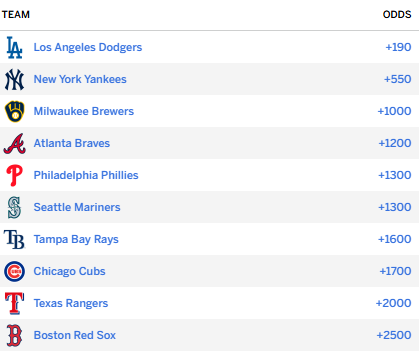
Right now the Dodgers sit at +190, the plus minus odds look funny at first glance, but here’s what they mean in plain English. If it’s a +, it means if you bet $100 you win back your stake as well as the amount after the +. Right now, bet $100 on the Dodgers, and if they win it all, you win $190, and your $100 stake, for a payout when you cash your ticket in of $290.
If it’s minus, it’s just turned around, if a favorite is -200, a $200 bet wins you $100, for a $300 total payout. The payouts are adjust for each wager amount to the correlating ratio.
In the markets you have to be aware of and account for certain levels of bias. If you’re in Las Vegas and you’re betting on the Dodgers, be aware that due to the proximity of the massive LA metro area to Vegas, that the Dodgers are often overbet by Dodgers fans who come to Vegas and take the boys in blue no matter what the line is. The sportsbooks don’t always change the lines fast enough to correct these numbers entirely (but with automated market makers this has changed significantly) and this is where the sharps like to pounce, it’s a reason they often wait until just before a game starts, until all the public money has come in, to lay massive wagers on an inflated line to get an edge. This is why you often see significant line movement before kickoff, right before a fight begins, and so on.
In my article last week, Dead Sox Come to Life, I discussed how the Boston Red Sox odds were at 35/1, or written in +/- style, +3500. As we see today in the above image, those odds have shifted to +2500, 25/1. The betting market has priced in the Red Sox 14 game win streak, now one win shy of the franchise record set by the 1946 club, and the odds of them winning the World Series have increased as more money has come in on Boston.
The Futures are a way to cut through the noise of the talking heads in the media and look at what the money is saying is going to happen, backed by some serious data analysis. The money says the most likely outcome is a Dodgers and Yankees World Series rematch. With the Dodgers having the edge in the potential matchup. But there’s a reason they play the games, the magic of sports is how often the unlikely actually occurs.
We’ll check in on where the odds have shifted after the trade deadline, and see who has done the most to best position their team for a run through October.