
Yes, the Honda Odyssey gag is an original meme. I’ll be posting more of these here on occasion — consider them the Sunday funnies or political cartoons of this publication.
The Odyssey, the highly polarizing new film from director Christopher Nolan, opened yesterday. The media and establishment cinema sites have heaped praise on it, and reports have come out that Rotten Tomatoes is pruning user reviews to keep the score high. Meanwhile, I’ve heard plenty of dissenting opinions on social media taking aim at the dialogue, acting, pacing, and overall production. I’ve read there are a few big set pieces that genuinely wow, but the film itself is a genuine disappointment to many longtime Nolan fans — and then there’s a shocking wrinkle where IMAX viewers are getting a significantly better view of the film than everyone in a regular theater.
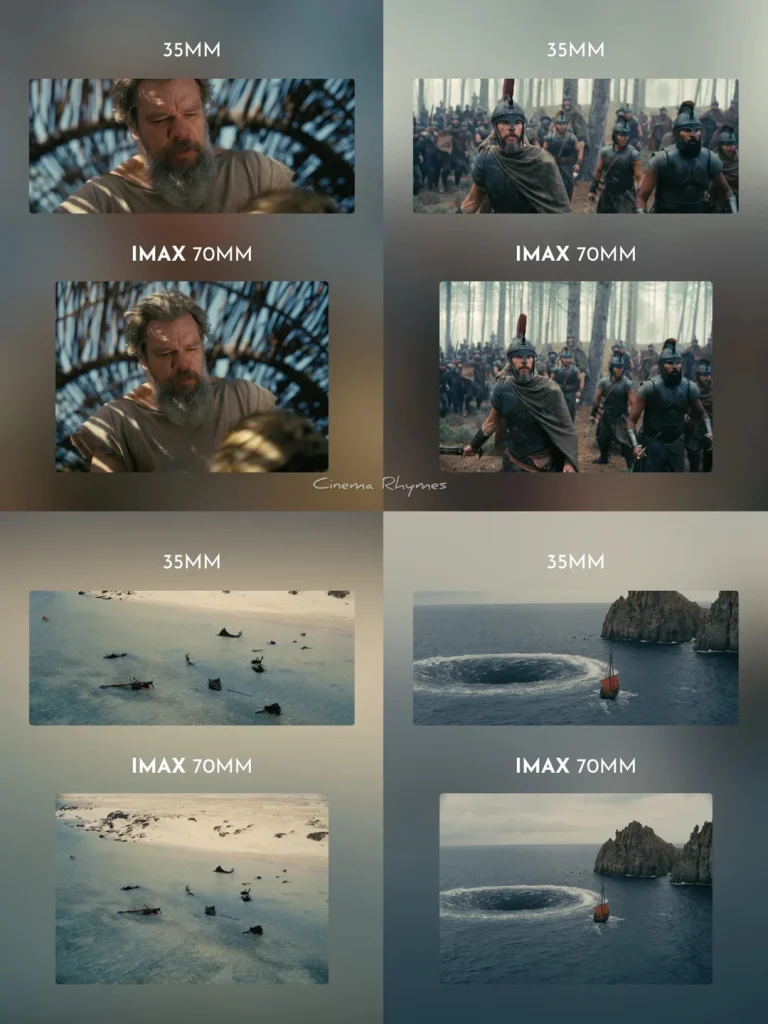
Here’s the short version of why: Nolan shot the entire film on IMAX cameras in the format’s full 1.43:1 aspect ratio — the tallest, most complete frame there is. But only a small handful of true IMAX 70mm theaters in the world can actually project that full frame. Everyone else is watching a cropped movie. Standard IMAX screens show it at 1.90:1. Regular digital and 35mm showings crop it down further still, to a conventional widescreen ratio. So depending on where you buy your ticket, you are not just getting a smaller screen — you are literally seeing less of the image Nolan shot. Same movie, meaningfully different film, and most people who buy a ticket this weekend have no idea which version they’re getting. And judging by the frame comparisons, the standard version of the film looks significantly worse. When has an artist of the craftsmanship of Christopher Nolan ever volunteered up their work to be circumcised by the aspect ratio of the vast majority of screens that will be displaying it? Stanley Kubrick famously sent theaters a written directive for Barry Lyndon in 1975, spelling out the exact aspect ratio projectionists were required to use and leaving no room for improvisation — which makes it all the more strange that a director as controlling as Nolan is letting The Odyssey go out into the world as two visibly different versions of itself.
One of the more interesting analyses I’ve come across is from Jonathan Pageau, who was highly impressed with the film and considers it, in his words, a Trojan Horse. Early in the film there’s a scene where the blind servant Eumaeus is training Telemachus in swordplay — the boy keeps getting beaten because his defense is too fast, so Eumaeus tells him to slow down, open his chest, invite the attack, and use his opponent’s own momentum against him. Pageau reads that as the key to the whole picture: Nolan does the same move on the audience, absorbing the blow of wokeness and inclusivity right up front so he can turn it back around on you by the end. His thesis, as I understand it: Nolan is aware of how repressive the current filmmaking environment is, has adopted that veneer to get the thing made and released, and has smuggled inside it a film that at its core is about the return of the father, the son inheriting his authority through an act of filiation, not revolution (as we have seen throughout the past decade in storytelling) and the restoration of an order that had been failed by the very people meant to guard it. The casting of Elliot Page, formerly Ellen Page, is intentional, as she represents Sinon (not from the Odyssey, from the Aeneid), the character who stays with the Trojan Horse to convince the Trojans that it is a gift. In this version, Sinon doesn’t know that this is a trick — he thinks it is a legitimate offering to Athena. Sinon is a shepherd, sent to war to fight as a “replacement man.” The casting being intentional by Nolan on two fronts: the Trojan Horse being delivered by the unaware, and because the character in the story is a stand-in for the real man who was to be tasked with this duty.
Several great filmmakers have worked inside repressive environments and still gotten their real, human, and even subtextual meanings across. Tarkovsky wrestled with faith, despair, and spirituality inside the Soviet Union. Alfred Hitchcock built an entire career navigating around the Hays Code. Jafar Panahi has kept making films in Iran after being formally banned from filmmaking by the regime — one of them reportedly smuggled out of the country on a flash drive hidden inside a cake.
But a hidden message does not a great film make. A film is the cumulative result of thousands and thousands of interconnected decisions — palette, acting, script, atmosphere, mood, visual effects, and on and on. The mystique of movies is that all of those variables blend together, and the end result lives or dies on the final product that enters our eyes and ears. If The Odyssey really is an attempt to subvert the subversion, does that make up for the areas where the film is lacking in other categories? Each person must decide that for themselves.
Nevertheless — this still has not moved me to want to view the film in theaters, or spend any money in support of it, though I am open to the possibility of Pageau’s interpretation. I believe the film will continue to be used as a bellwether in the culture war playing out across the West. Whether it’s ultimately remembered as the high-water mark of Hollywood’s self-destruction, or as a brilliant Trojan Horse rammed into the heart of modern deconstructionist art, is a fate yet to be known.